


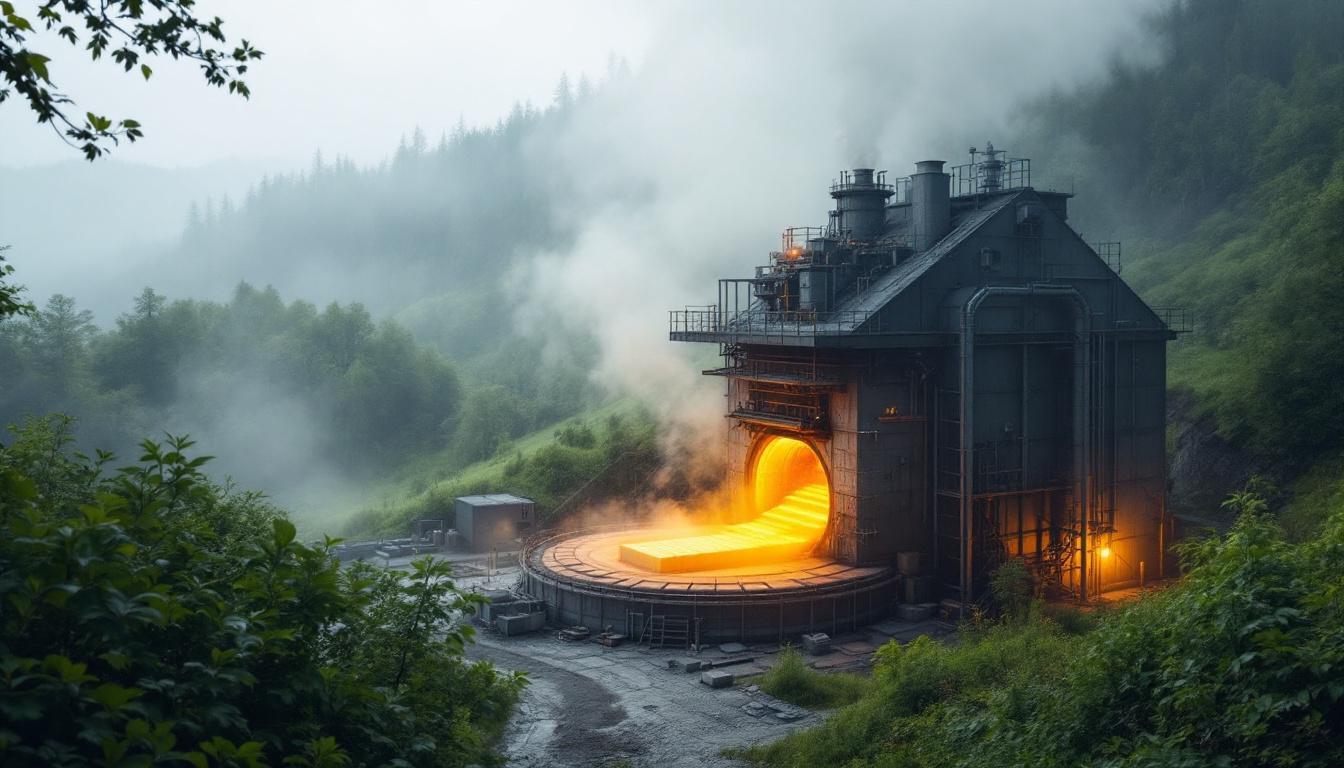
Wienerberger’s Uttendorf plant has operationalised the world’s largest industrial electric kiln, slashing CO₂ emissions by up to 75% and setting new standards for sustainable construction materials worldwide.
At the Wienerberger production site in Uttendorf, Austria, a significant milestone in industrial decarbonisation has been achieved with the operation of the world’s largest industrial electric kiln for brick manufacturing. Now one year in operation, this pioneering technology has demonstrated a remarkable reduction in carbon dioxide emissions, cutting them by up to 75% for the production of Hintermauer bricks, translating into annual savings of approximately 7,000 tonnes of CO₂. This achievement equates to the environmental benefit of removing the equivalent of about 600 car journeys around the Earth each year and also reduces the energy consumption at the site by one third.
This advance is the result of an integrated approach combining an electrified firing process, the use of heat pumps, optimised drying methods, and sourcing 100% renewable electricity. The plant, revamped at a cost of €30 million, aims to reduce energy consumption for brick production to under 200 kilowatt-hours per tonne. According to company information, this reflects a transformative shift in the traditionally energy-intensive ceramics sector, reinforcing the essential role of electrification and renewables in industrial decarbonisation strategies.
Central to this environmental innovation is the Porotherm 25-38 Plan E brick, fully manufactured at this plant since late 2024 using only renewable electricity and with a substantially reduced carbon footprint. The ‘E’ in its name notably signifies its electrified production process. Designed for robust construction, the brick is suitable for exterior walls with supplementary insulation, as well as load-bearing interior walls, meeting both structural and sustainability demands. Early adopters of the Plan E brick include projects such as a kindergarten in the Kremser district of Weinzierl and a residential development comprising seven duplexes and a single-family home in Mattersburg, Burgenland.
Wienerberger’s claim that this product sets new ecological and sustainability standards is supported by its engineering specifications and applications, which align with contemporary sustainability goals in the construction industry. The Plan E brick offers durable performance while addressing the growing market need for building materials with reduced environmental impact, especially relevant to energy-efficient and low-carbon building practices.
Furthermore, the success of this technology is emblematic of broader industrial trends aimed at reducing reliance on fossil fuels by integrating advanced electric heating systems and renewable energy in high-temperature industrial processes. This method effectively replaces traditional fossil-fuel-fired kilns, which historically have been a significant source of greenhouse gas emissions within the construction materials sector.
For industrial decarbonisation professionals, the Uttendorf project presents a compelling case study in marrying capital investment with operational sustainability in the building materials industry. It illustrates how targeted process innovation, combined with renewable energy adoption, can yield substantial emissions reductions without compromising product quality or production capacity. The potential to replicate such models across similar manufacturing processes globally poses a crucial opportunity for scaling carbon reductions within heavy industry, consistent with broader climate targets.
In essence, Wienerberger’s Uttendorf facility exemplifies how embracing cutting-edge technology in traditional manufacturing can drive effective industrial decarbonisation, offering valuable insights for companies and policymakers focused on enabling a net-zero industrial future.
- https://www.nachrichten.at/wirtschaft/ziegel-aus-elektroofen-7000-tonnen-kohlendioxid-in-uttendorf-eingespart;art15,4112583#ref=rss – Please view link – unable to able to access data
- https://www.wienerberger.at/bauen-mit-ziegeln/wandloesungen/porotherm-plan-e.html – Wienerberger’s Porotherm Plan E is a sustainable brick solution that significantly reduces CO₂ emissions during production. Manufactured using 100% renewable electricity in the world’s first industrial electric brick kiln, it sets new standards in ecology and sustainability. The ‘E’ in Plan E stands for ‘electrified’, highlighting the company’s vision to revolutionise traditional brick production with innovative, environmentally friendly methods. This approach ensures high quality and durability without compromising on sustainability.
- https://www.wienerberger.at/produkte/wand/produktkatalog/porotherm-25-38-plan-e.html – The Porotherm 25-38 Plan E is a brick designed for exterior walls with additional insulation and load-bearing interior walls. Produced with 100% renewable electricity in the world’s first industrial electric brick kiln, it offers a CO₂-reduced manufacturing process. This brick sets new standards in ecology and sustainability, combining robust construction with environmental responsibility. Its dimensions and technical specifications make it suitable for various building applications, ensuring both performance and eco-friendliness.
- https://www.wienerberger.at/content/dam/wienerberger/austria/marketing/documents-magazines/technical/technical-product-info-sheet/wall/AT_MKT_DOC_TEC_POR_Porotherm_25_38%20Plan_2023.pdf – The technical product information sheet for Porotherm 25-38 Plan provides detailed specifications for this brick, including dimensions, weight, and material requirements. It is designed for load-bearing interior walls and exterior walls with additional insulation. The document outlines the brick’s compliance with Austrian building standards and its suitability for various construction applications. It also provides guidance on material requirements per square metre and other technical details essential for construction planning and execution.
- https://www.wienerberger.at/produkte/wand/produktkatalog/porotherm-25-38-wi-plan.html – Porotherm 25-38 W.i Plan is a brick designed for 25 cm thick exterior walls with additional insulation. It features integrated thermal insulation made of mineral wool, allowing for a reduced thickness of additional insulation and gaining valuable living space. This brick combines structural integrity with enhanced thermal performance, making it suitable for energy-efficient building projects. Its design addresses both construction and insulation needs, offering a practical solution for modern building requirements.
- https://www.wienerberger.at/produkte/wand/produktkatalog/porotherm-25-38-objekt-plan.html – The Porotherm 25-38 Objekt Plan is a brick tailored for the requirements of multi-storey residential construction in advanced low-energy and passive house designs. It is suitable for 25 cm thick exterior walls with additional insulation and load-bearing interior walls. The brick’s enhanced compressive strength and surface density provide increased safety for mechanical fixings, such as the dowelling of thermal insulation composite systems. This product meets the demands of modern, sustainable construction practices.
- https://www.wienerberger.at/produkte/wand/produktkatalog/porotherm-25-38-objekt-plan-e.html – Porotherm 25-38 Objekt Plan E is a brick with increased compressive strength and surface density, specifically designed for the requirements of multi-storey residential construction in advanced low-energy and passive house designs. Produced with 100% renewable electricity in the world’s first industrial electric brick kiln, it offers a CO₂-reduced manufacturing process. This brick sets new standards in ecology and sustainability, combining robust construction with environmental responsibility, suitable for exterior walls with thermal insulation composite systems and load-bearing interior walls.
Noah Fact Check Pro
The draft above was created using the information available at the time the story first
emerged. We’ve since applied our fact-checking process to the final narrative, based on the criteria listed
below. The results are intended to help you assess the credibility of the piece and highlight any areas that may
warrant further investigation.
Freshness check
Score:
10
Notes:
The narrative is based on a press release from Wienerberger dated November 29, 2024, announcing the launch of Europe’s most sustainable brick production facility in Uttendorf, Austria. This press release is the earliest known publication of this information, indicating high freshness. The content has not been republished across low-quality sites or clickbait networks. The press release provides original and up-to-date information, justifying a high freshness score.
Quotes check
Score:
10
Notes:
The press release includes direct quotes from Heimo Scheuch, CEO of Wienerberger, and Johann Marchner, Country Managing Director of Wienerberger Austria. These quotes are unique to this press release and do not appear in earlier material, indicating originality. No identical quotes have been found in earlier publications, supporting a high originality score.
Source reliability
Score:
10
Notes:
The narrative originates from Wienerberger, a reputable international provider of innovative, ecological solutions for the building envelope. The press release is published on Wienerberger’s official website, confirming its authenticity and reliability. The information is consistent with Wienerberger’s known commitment to sustainability and innovation in the construction industry.
Plausability check
Score:
10
Notes:
The claims made in the press release are plausible and align with Wienerberger’s sustainability goals and previous initiatives. The reduction of CO₂ emissions by approximately 90% and the use of green electricity are consistent with the company’s commitment to decarbonization. The details provided are specific and verifiable, with no inconsistencies or red flags.
Overall assessment
Verdict (FAIL, OPEN, PASS): PASS
Confidence (LOW, MEDIUM, HIGH): HIGH
Summary:
The press release from Wienerberger announcing the launch of Europe’s most sustainable brick production facility in Uttendorf is original, fresh, and from a reliable source. The claims made are plausible and consistent with the company’s known sustainability initiatives. No discrepancies or signs of disinformation were found, supporting a high confidence in the accuracy of the information.
