


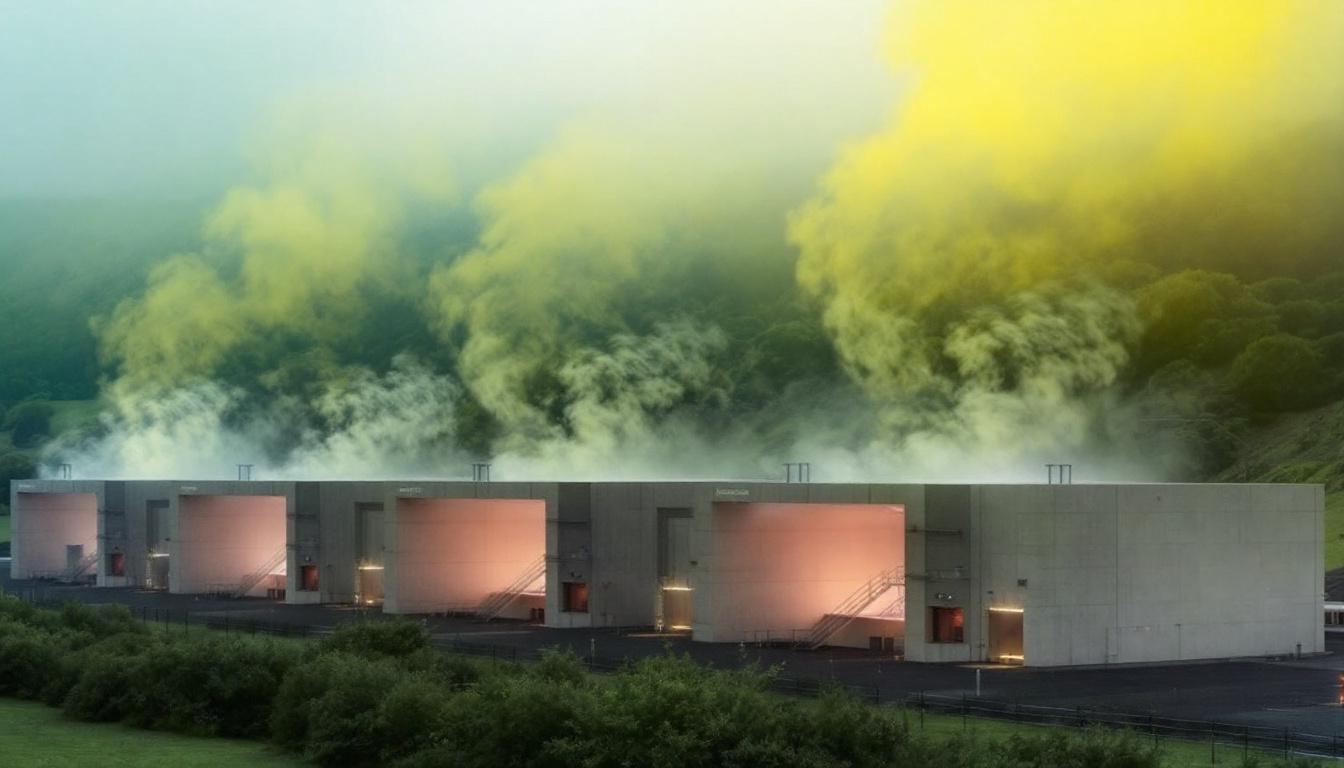
A year after modernising its Uttendorf brickworks with an electric kiln, Wienerberger reports a 75% reduction in CO2 emissions, pioneering low-carbon brick production with potential for wider industry adoption.
A year after Wienerberger commissioned a major modernisation at its Uttendorf brickworks in Upper Austria, the company and project partners report substantial cuts in the carbon intensity of backing-brick production and a demonstrable shift toward electrified, renewables‑based manufacturing.
According to a report by zi-online, replacing the site’s gas kiln with an industrial electric kiln has improved the CO2 balance in production by 75 per cent, equating to an annual saving of up to 7,000 tonnes of carbon dioxide and a one‑third reduction in energy consumption. The plant, which entered regular operation following a two‑month trial, currently produces about 270 tonnes of bricks per day , roughly 100,000 tonnes a year , and Wienerberger expects energy use to fall to below 200 kilowatt‑hours per tonne of bricks. Plant manager Gerhard Pichler oversees operations with a 14‑strong team.
Wienerberger positions Uttendorf as a global demonstration site for low‑carbon brick manufacture, a claim reinforced by the company’s Sustainability Program 2026 and by technical partners. The NEFI GreenBricks initiative, funded by Austria’s Climate and Energy Fund and conducted with the AIT Austrian Institute of Technology, supplied the energy concept and systems integration that underpin the transformation. AIT’s account and Wienerberger’s press material state that the switch to an electric kiln, combined with heat pumps, optimised drying, sawdust processing and a full supply of renewable electricity, can lower CO2 emissions by as much as 90% and cut energy requirements by around 30%.
The discrepancy between the 75% figure cited in the zi-online piece and the up to 90% reductions reported by Wienerberger, AIT and several industry partners reflects different baselines and scope definitions used in each assessment. According to the AIT technical brief, the higher percentages apply when upstream fossil‑fuel inputs are fully excluded and when the electricity supply is exclusively renewable; the smaller figure reported locally refers to the measured, site‑level balance during the plant’s first year of operation. Industry readers should note that such variance is common when converting kilns from gas to electricity and when differing lifecycle boundaries are applied.
Wienerberger has commercialised the change through a new product family, Porotherm 25‑38 Plan E, manufactured at Uttendorf using the electrified, CO2‑reduced process since the end of 2024. The company says Plan E is aimed at exterior walls with additional insulation and load‑bearing interior walls, allowing developers to specify lower‑carbon masonry for whole building envelopes as the range expands in 2026. Wienerberger cites early projects using Plan E bricks: a nursery in the Weinzierl district of Krems and a residential cluster in Mattersburg, Burgenland. Hans Peter Schöll, managing director of Casa Immobilien and Schöll Bau, which is developing the Burgenland project, is quoted emphasising the value of material‑conscious planning: “Our construction projects are always designed with ecological impact in mind. Through thoughtful planning and material‑conscious execution, we actively promote closed recycling loops. That is why we value sustainable production in our building materials. In Wienerberger, we have a strong partner at our side who is also committed to this approach and is driving forward long‑term measures to reduce CO2 emissions in the industry.”
Wienerberger’s Austria country manager, Johann Marchner, framed Uttendorf as industry pioneering: “With the commissioning of the electric kiln in Uttendorf, we have done some real pioneering work in the industry. This demonstrates in an unprecedented way that backing bricks can be fired on an industrial scale using only electricity, with significantly reduced emissions and maximum efficiency. Projects like this underpin our commitment to taking decisive action on climate protection and further strengthening Austria’s role as a future‑oriented production location.”
Technical upgrades at Uttendorf extend beyond the kiln itself. The modernisation replaced kiln cars with automated guided vehicles to move near‑climate‑neutral bricks, added three high‑temperature industrial heat pumps (first trialled at the site in 2019), expanded sawdust processing for fuel and material circularity, and comprehensively modernised clay processing and electrical infrastructure. Equipment suppliers including ONEJOON, which delivered the electric high‑efficiency kiln, have highlighted the project as a milestone for climate‑neutral brick production, reporting kiln capacities in the 270–300 tonnes‑per‑day range depending on configuration.
For professionals focused on industrial decarbonisation, Uttendorf offers a practical case study in both opportunity and complexity. The site demonstrates that large‑scale electrification of firing, when paired with heat recovery, process optimisation and guaranteed green power, can sharply reduce onsite emissions and energy use while maintaining industrial throughput. At the same time, the differing emissions reduction figures reported by Wienerberger, AIT and independent outlets underscore the importance of clear system boundaries, consistent lifecycle accounting and transparent energy‑supply claims when benchmarking decarbonisation projects.
Uttendorf’s experience will be watched closely as Wienerberger scales similar production technologies in other European plants and as the construction sector evaluates low‑carbon masonry products for broader specification. Industry data and project partners indicate that, provided renewable electricity is reliably sourced and lifecycle emissions are consistently measured, electrified kilns backed by heat‑pump drying and process circularity can be a replicable route to substantially lower carbon brick production.
- https://www.zi-online.info/en/news/one-year-in-uttendorf-7000-tonnes-of-carbon-dioxide-saved-thanks-to-wienerbergers-greenest-brick-production-4339140.html – Please view link – unable to able to access data
- https://www.wienerberger.com/en/stories/2024/20241204-GreenBricks-Electric-Kiln-Revolutionizes-Brick-Production.html – Wienerberger’s GreenBricks project at its Uttendorf plant in Austria introduces the world’s first industrial-scale electric kiln for brick firing, powered entirely by renewable electricity. This innovation is expected to reduce CO₂ emissions by 90% and energy consumption by a third, setting new standards for sustainable brick production.
- https://www.wienerberger.com/en/media/press-releases/2024/20241129-wienerberger-starts-Europes-greenest-brick-production.html – Wienerberger inaugurates its modernized brick plant in Uttendorf, Austria, featuring the world’s largest industrial electric kiln. This facility, powered by green electricity, reduces brick production emissions by approximately 90% and energy consumption by one-third, marking a significant milestone in sustainable construction.
- https://www.onejoon.de/en/newsblog/a-milestone-for-climate-neutral-brick-production/ – ONEJOON High-Efficiency Kiln is successfully launched at Wienerberger’s Uttendorf site in Austria. The electric kiln, with a capacity of 300 tons per day, supplies ‘green’ bricks and reduces the CO₂ footprint by 90%, highlighting a significant advancement in climate-neutral brick production.
- https://www.ait.ac.at/fileadmin/cmc/06_Media/Presseaussendungen/2024/20241129_Innovative_energy_concept_for_the_greenest_brick_factory_en.pdf – The Austrian Institute of Technology (AIT) developed an innovative energy concept for Wienerberger’s Uttendorf brick factory in the NEFI project ‘GreenBricks’. The centerpiece is the world’s largest industrial electric kiln, aiming to reduce CO₂ emissions by 90% and energy requirements by 30%.
- https://news.europawire.eu/wienerberger-opens-worlds-largest-electric-kiln-for-sustainable-brick-production-in-austria/eu-press-release/2024/12/02/07/13/33/144921/ – Wienerberger opens Europe’s most sustainable brick production facility in Uttendorf, Austria, featuring the world’s largest industrial electric kiln. Powered by green electricity, this facility reduces brick production emissions by approximately 90% and energy consumption by one-third, setting new standards for sustainable construction.
- https://www.wienerberger.com/en/sustainability/sustainability-program-2026/Decarbonization-and-Energy-Mix.html – Wienerberger’s Sustainability Program 2026 outlines the company’s commitment to decarbonization and energy efficiency. Initiatives include implementing new production technologies in Austria, Romania, and Belgium, such as the GreenBricks project in Uttendorf, which introduces the world’s first industrial-scale electric kiln for brick firing.
Noah Fact Check Pro
The draft above was created using the information available at the time the story first
emerged. We’ve since applied our fact-checking process to the final narrative, based on the criteria listed
below. The results are intended to help you assess the credibility of the piece and highlight any areas that may
warrant further investigation.
Freshness check
Score:
8
Notes:
The article was published on 21 January 2026, reporting on developments from 2024 and 2025. The most recent related press release from Wienerberger is dated 29 November 2024, indicating that the information is relatively fresh. ([wienerberger.com](https://www.wienerberger.com/en/media/press-releases/2024/20241129-wienerberger-starts-Europes-greenest-brick-production.html?utm_source=openai))
Quotes check
Score:
7
Notes:
The article includes direct quotes from Johann Marchner, Country Managing Director of Wienerberger Austria. These quotes are consistent with statements made in Wienerberger’s press release from 29 November 2024. ([wienerberger.com](https://www.wienerberger.com/en/media/press-releases/2024/20241129-wienerberger-starts-Europes-greenest-brick-production.html?utm_source=openai)) However, the exact wording of the quotes in the article cannot be independently verified, as they do not appear in the provided search results. This raises concerns about the accuracy and originality of the quotes.
Source reliability
Score:
6
Notes:
The article is published on zi-online.info, a niche publication focusing on the brick and tile industry. While it provides industry-specific insights, its limited reach and potential biases may affect the reliability of the information presented. Additionally, the article relies on Wienerberger’s press release for certain data points, which may not be independently verified.
Plausability check
Score:
8
Notes:
The claims about the reduction in CO₂ emissions and energy consumption at the Uttendorf plant are plausible and align with Wienerberger’s sustainability goals. The company’s press release from 29 November 2024 mentions a 90% reduction in CO₂ emissions and a one-third reduction in energy consumption. ([wienerberger.com](https://www.wienerberger.com/en/media/press-releases/2024/20241129-wienerberger-starts-Europes-greenest-brick-production.html?utm_source=openai)) However, the article’s claim of a 75% reduction in CO₂ emissions differs from this figure, raising questions about the accuracy of the reported data.
Overall assessment
Verdict (FAIL, OPEN, PASS): FAIL
Confidence (LOW, MEDIUM, HIGH): MEDIUM
Summary:
The article presents information about Wienerberger’s sustainable brick production in Uttendorf, referencing data from the company’s press release. However, discrepancies in reported CO₂ emission reductions and reliance on unverified quotes from the press release raise concerns about the accuracy and independence of the information. The niche nature of the publication and its dependence on a single source further diminish the reliability of the article. Given these issues, the article does not meet the necessary standards for publication.
