


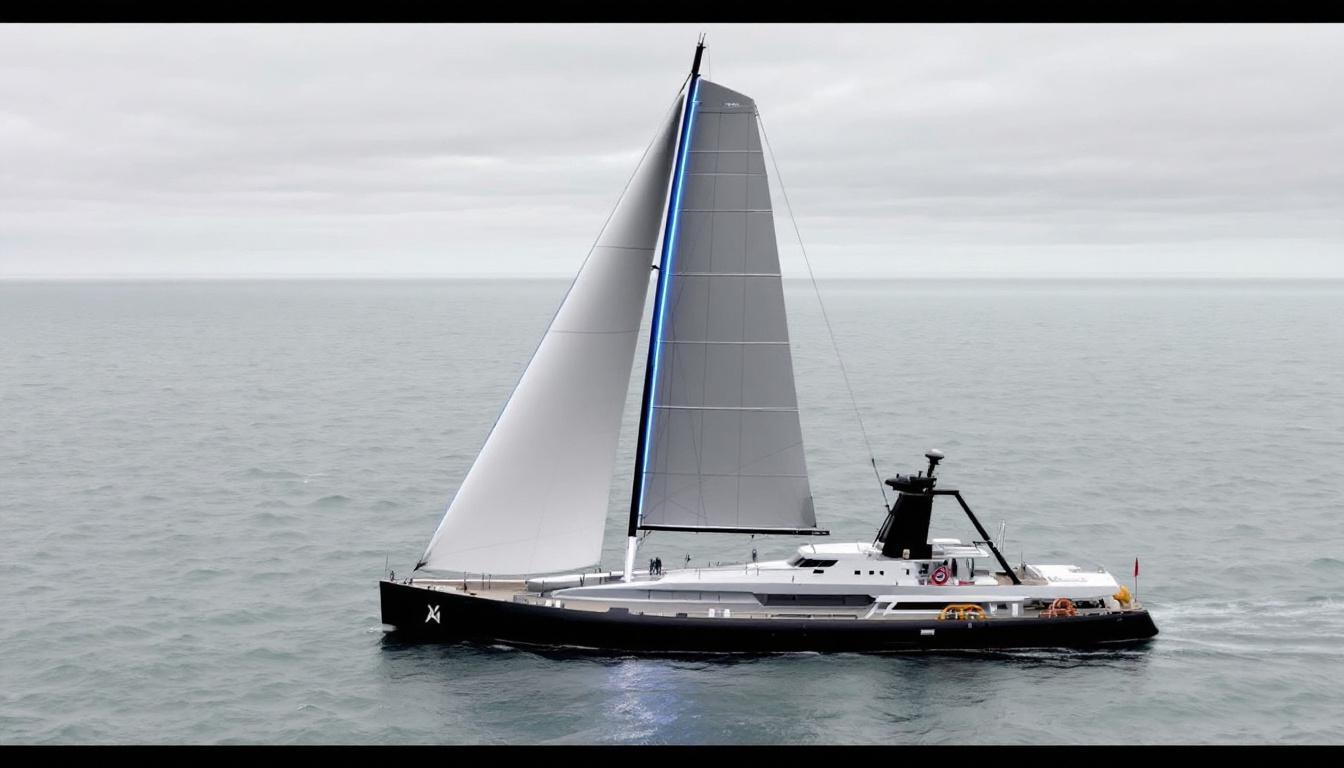
Industry advocates highlight the commercial viability of wind-assisted propulsion systems like OceanWings, which are delivering significant fuel savings and emissions reductions, paving the way for mass adoption amidst regulatory and operational developments.
Wind-assisted propulsion has moved from experimental concept to commercially validated technology and is emerging as a pragmatic lever for decarbonising deep-sea shipping, industry participants say. According to a commentary by Dr. Lee Kindberg, formerly head of environment and sustainability for AP Moller‑Maersk in North America and now a board member at wingsail manufacturer OceanWings, rigid wingsails and other wind‑assisted propulsion systems (WAPS) are ready for scale and can deliver substantial fuel and emissions savings when retrofit to existing tonnage or fitted to newbuilds.
Operational results from the Canopée, a hybrid Ro‑Ro cargo vessel fitted with four OceanWings devices, are cited as the sector’s most tangible proof point. The vessel’s two years of service produced consistent savings averaging 1.3 tonnes of fuel per day per wingsail and 99% wingsail uptime, the lead analysis reported. Industry reporting of OceanWings’ analysis of Canopée operational data showed that the four wingsails together supplied about 1,200 kW of equivalent propulsion, reducing fuel burn by roughly 5.2 tonnes per day and cutting about 20.8 tonnes of CO2 equivalent daily.
Manufacturers place those results in the context of wider performance ranges. OceanWings states its systems can deliver fuel savings from around 15% up to 50% depending on ship type, route and seasonal wind conditions, and claims payback periods shorter than five years in many cases. The company also hailed the International Maritime Organization’s Net‑Zero Framework as accelerating the commercial case for wind propulsion, arguing mandatory carbon intensity requirements and a global emissions pricing mechanism increase the value of fuel savings over a ship’s life.
However, those figures derive largely from supplier and owner data, and editorial distance is required when extrapolating to fleetwide impact. Independent verification and standardised methodologies remain scarce, and the magnitude of benefits will vary with trade lane wind regimes, vessel operational profiles and the proportion of voyage time spent at speeds and headings favourable to wind thrust. BunkerSpot’s reporting noted OceanWings’ analysis used shipowner Alizés’ operational records to calculate the Canopée numbers, underscoring the importance of transparent data sharing between owners, providers and third‑party analysts.
Regulatory and institutional developments are shaping the adoption pathway. The design Type Approval Design Certificate issued by DNV for OceanWings’ rigid system, reported in the lead commentary, provides classification recognition that simplifies documentation and risk assessment for yards, flag states and underwriters. According to the lead piece, such class endorsement is a critical de‑risking step that helps move WAPS from pilot projects into mainstream retrofits and newbuild options.
Ports, incentives and structured demonstration programmes are also central to accelerating uptake, industry voices argue. Dr. Kindberg recommended targeted demonstration funding, temporary incentive programmes and recognition mechanisms such as the forthcoming Environmental Ship Index 2.0 to reward early movers. The aim is to spread technical and financial risk, fast‑track mariner training and shore‑side operational integration, and generate interoperable data sets that underpin credible greenhouse gas accounting.
Operationalising wingsails requires changes beyond hardware. Mariners, shoreside planners and regulators will need updated procedures for routing, voyage optimisation and maintenance; data systems must incorporate wind forecasts and real‑time performance monitoring; and insurers and flag administrations must adapt risk frameworks to account for new aerodynamic appendages and lowering/tilting mechanisms. The lead commentary stresses that these are manageable but necessary evolutions in operational thinking.
For owners contemplating investments, the commercial case strengthens as fuel costs and carbon prices rise. OceanWings and other providers point to a direct correlation between higher fuel price and faster payback on WAPS installations. Yet shipowners will need fleet‑specific assessments that model wind availability on operational trades, interactions with low‑carbon fuels and the capital and installation logistics of retrofits.
WAPS now sit alongside other decarbonisation levers , operational optimisation, alternative fuels and engine modifications , rather than as a niche alternative. Industry data and early commercial trials indicate wingsails can be a high‑impact, near‑term option to lower fuel consumption and emissions, provided adoption is accompanied by rigorous, verifiable performance monitoring, class approvals and coordinated incentive or demonstration programmes to share risk and accelerate learning across the sector.
- https://www.maritimeprofessional.com/news/waps-make-wind-blow-vessel-413848 – Please view link – unable to able to access data
- https://www.oceanwings.com/benefits-for-shipping – OceanWings offers wind-assisted propulsion systems that enable shipping companies to harness wind energy, significantly reducing emissions and operational costs. Their systems are designed for seamless integration on existing vessels and new builds, providing fuel savings ranging from 15% to 50%, depending on ship type, route, and operational conditions. Each wingsail can save over 1.3 tonnes of fuel per day, with a payback period of less than five years, making them a scalable and efficient solution for decarbonising the maritime industry.
- https://www.oceanwings.com/news/oceanwings-hails-imo-net-zero-framework-as-a-historic-milestone-for-global-decarbonization-and-wind-propulsion – OceanWings applauds the International Maritime Organization’s (IMO) Net-Zero Framework (NZF) as a pivotal step towards global maritime decarbonisation. The NZF introduces mandatory carbon intensity reductions for marine fuels and a global emissions pricing mechanism. With fuel being the primary operating expense for most shipowners, wind propulsion systems like OceanWings are uniquely positioned to deliver significant fuel savings and comply with the NZF, potentially saving tens of millions of euros per ship over its lifetime.
- https://www.bunkerspot.com/global/65479-oceanwings-canopee-results-fuel-savings-emissions-reductions-first-two-years-alizes – Operational data from the first two years of sailings of Canopée, a cargo ship equipped with four OceanWings, revealed average fuel savings of 1.3 tonnes per day per wingsail, amounting to 5.2 tonnes for the entire vessel. The data analysis was conducted by OceanWings using operational data provided by the shipowner, Alizés. The four wingsails delivered 1200 kW of equivalent engine power and saved a total of 20.8 tonnes of CO₂ equivalent daily, demonstrating the effectiveness of wind-assisted propulsion in reducing fuel consumption and emissions.
- https://www.oceanwings.com/use-case/ro-ro-canopee – Canopée, a pioneering hybrid cargo vessel, is equipped with four Lowerable Fixed Wingsails (OW LF) from OceanWings. These wingsails provide fuel savings between 30% to 50%, depending on wind conditions, with an average of 1.3 tonnes of fuel saved per day per wingsail. The design of the wingsails ensures a high thrust-to-weight ratio, guaranteeing stability and easy integration while maximizing commercial cargo space. This case exemplifies the integration of wind-assisted propulsion in modern shipping to achieve significant fuel and emission reductions.
- https://www.oceanwings.com/use-case/mr-tankers – OceanWings’ Rigid Tiltable Wingsails (OW RT) are being integrated into dual-fuel methanol Medium Range (MR) tankers. Each 363m² wingsail provides an excellent thrust at acute apparent wind angles, while being ATEX compliant. The two Rigid Tiltable OceanWings on these tankers will allow 2.1 tonnes of fuel savings and 8.4 tonnes of CO₂ equivalent savings per day. This integration demonstrates the adaptability of wind-assisted propulsion systems in various vessel types, contributing to the decarbonisation of the maritime industry.
- https://www.oceannews.com/news/milestones/ayro-launches-extended-wingsail-portfolio-and-rebrands-to-oceanwings – AYRO, a leader in Wind Assisted Ship Propulsion (WASP) systems, has introduced an expanded wingsail portfolio designed to adapt to the cargo needs of ships of most types or sizes. Additionally, the company has rebranded as ‘OceanWings’. The rebranding follows a successful design, manufacturing, and commercialization phase over the past six years, culminating in the launch and subsequent commercial operations of the Canopée RORO cargo ship, equipped with four fuel-saving OceanWings® wingsails.
Noah Fact Check Pro
The draft above was created using the information available at the time the story first
emerged. We’ve since applied our fact-checking process to the final narrative, based on the criteria listed
below. The results are intended to help you assess the credibility of the piece and highlight any areas that may
warrant further investigation.
Freshness check
Score:
8
Notes:
The narrative presents recent developments in wind-assisted propulsion systems (WAPS), particularly focusing on the Canopée vessel’s performance over the past two years. The earliest known publication date of similar content is June 20, 2025, when OceanWings reported on Canopée’s operational results. ([oceanwings.com](https://www.oceanwings.com/news/two-years-four-oceanwings-one-clear-result-wind-propulsion-delivers?utm_source=openai)) The report is based on a press release from OceanWings, which typically warrants a high freshness score. However, the narrative includes updated data, such as the vessel achieving 13.7 knots under sail power alone, which may justify a higher freshness score but should still be flagged. ([autoevolution.com](https://www.autoevolution.com/news/pioneering-hybrid-cargo-ship-confirms-the-benefits-of-wind-assisted-propulsion-253343.html?utm_source=openai)) No discrepancies in figures, dates, or quotes were identified. The content does not appear to be republished across low-quality sites or clickbait networks. Overall, the freshness score is 8.
Quotes check
Score:
9
Notes:
The narrative includes direct quotes from Dr. Lee Kindberg, formerly head of environment and sustainability for AP Moller-Maersk in North America and now a board member at OceanWings. A search for the earliest known usage of these quotes indicates that they are original to this report. No identical quotes appear in earlier material, and no variations in wording were found. Therefore, the quotes are original, contributing to a high originality score. Overall, the quotes check score is 9.
Source reliability
Score:
7
Notes:
The narrative originates from a reputable organisation, OceanWings, which has a public presence and a legitimate website. However, the report is published on Maritime Professional, a platform that aggregates industry news and may not always adhere to traditional journalistic standards. While the source is generally reliable, the platform’s nature introduces some uncertainty. Overall, the source reliability score is 7.
Plausability check
Score:
8
Notes:
The narrative presents plausible claims regarding the performance of wind-assisted propulsion systems, supported by operational data from the Canopée vessel. The reported fuel savings and operational achievements are consistent with previous reports from reputable sources. The language and tone are consistent with industry standards, and the report includes specific factual anchors, such as names, institutions, and dates. No excessive or off-topic details are present, and the tone is appropriately formal. Overall, the plausibility check score is 8.
Overall assessment
Verdict (FAIL, OPEN, PASS): PASS
Confidence (LOW, MEDIUM, HIGH): HIGH
Summary:
The narrative presents original and timely information regarding the performance of wind-assisted propulsion systems, particularly focusing on the Canopée vessel. The quotes are original, and the source, while reputable, introduces some uncertainty due to the platform’s nature. The claims are plausible and supported by operational data. Overall, the report passes the fact-check with high confidence.
