

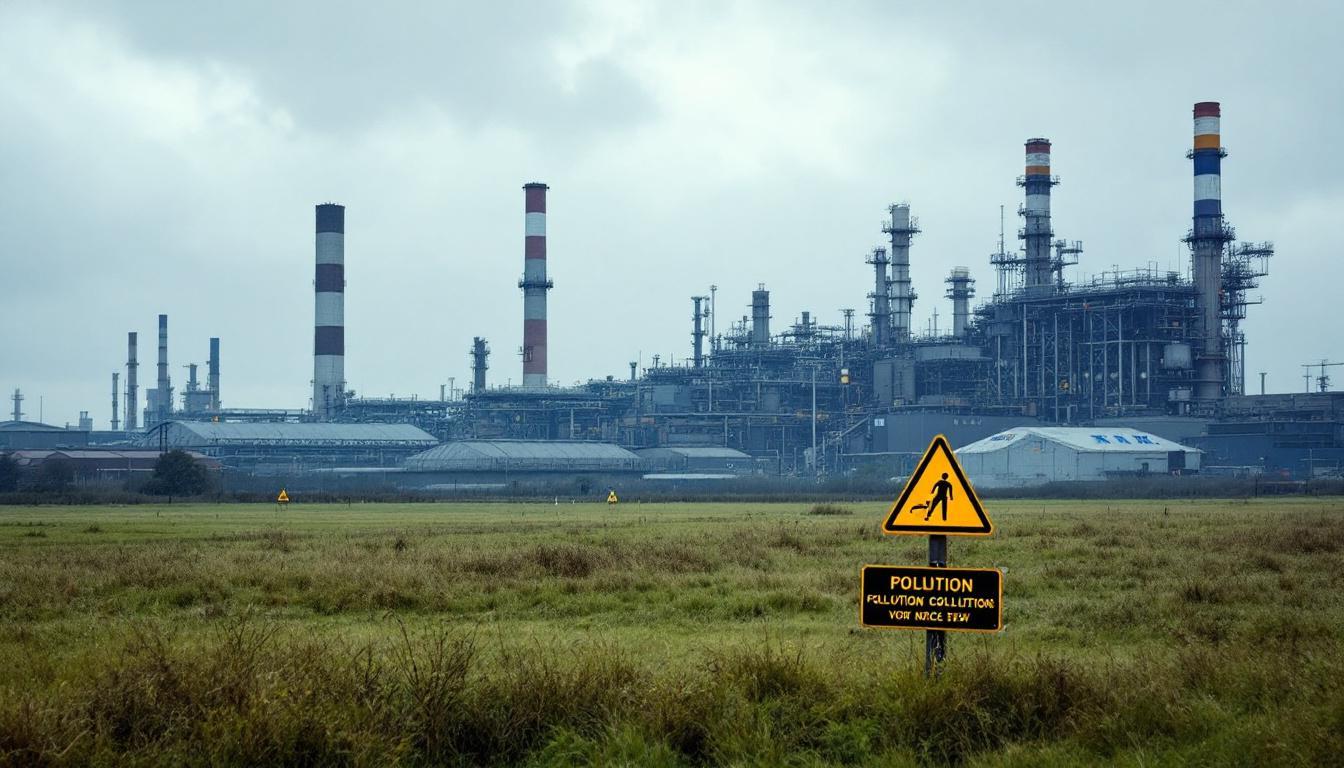
Dutch regulators impose a further €8.5 million fine on Tata Steel’s IJmuiden plant amid ongoing emissions breaches, signalling escalating regulatory pressure ahead of new EU climate and trade policies affecting industrial decarbonisation efforts.
Tata Steel’s IJmuiden plant in the Netherlands has been hit with another fine of more than €8.5 million after regulators found continued breaches of emissions rules, underscoring the pressure on European steelmakers to show tangible progress on decarbonisation rather than promises alone.
According to Dutch media reports cited by the NL Times, the North Sea Canal Area Environment Service said tests carried out in April and May last year showed excessive emissions from one of the site’s coking operations. The latest penalty follows a similar sanction imposed in January, based on the company’s own reported data, and the authority said the maximum financial penalty has now been reached.
The regulator is now assessing what the repeated violations could mean for the plant’s operating permit. Options under review reportedly include further restrictions on operations, raising the prospect that the consequences could move beyond fines into direct operational limits.
The case lands at a moment when EU steel policy is tightening on several fronts. On 13 April, the Council and European Parliament agreed a provisional deal to replace the bloc’s steel safeguard regime, extending protection against global overcapacity and trade diversion as the current measures are due to expire on 30 June 2026.
At the same time, the Carbon Border Adjustment Mechanism is entering a more consequential phase. EUROFER said this month that the first carbon certificate prices are due to be published, marking the point at which importers begin to see the financial burden of CBAM more clearly. The association backs the mechanism in principle, but says further fixes are needed to make it fully effective and fair.
The contrast is stark for domestic producers. Research published in ScienceDirect estimates that the EU steel industry accounts for around 7% of global CO2 emissions, a reminder of the scale of the sector’s decarbonisation challenge and the investment still required to bring production closer to climate neutrality.
For industrial buyers, policymakers and investors, the Dutch case highlights a broader issue: Europe is asking the market to pay more attention to embedded carbon, but compliance expectations for domestic producers are rising just as fast. When regulators are willing to escalate from fines to licence questions, emissions performance is no longer a side issue for steelmakers.
- https://steelnews.biz/eu-steel-producer-imposed-for-emissions-violations/ – Please view link – unable to able to access data
- https://nltimes.nl/2026/04/17/tata-steel-faces-new-eu85-million-fine-continued-emissions-breaches – Tata Steel in IJmuiden faces an additional fine exceeding €8.5 million after regulators found ongoing excessive emissions at one of its plants. The North Sea Canal Area Environment Service confirmed violations based on tests from April and May of the previous year. This follows a similar fine imposed in January, based on Tata Steel’s self-reported data. The maximum penalty has now been reached, and the Environment Service is assessing the implications for the facility’s operating permit, with potential additional fines or operational restrictions under consideration. ([nltimes.nl](https://nltimes.nl/2026/04/17/tata-steel-faces-new-eu85-million-fine-continued-emissions-breaches?utm_source=openai))
- https://www.consilium.europa.eu/en/press/press-releases/2026/04/13/council-and-european-parliament-strike-deal-to-protect-eu-s-steel-industry-from-global-overcapacity/ – The Council presidency and the European Parliament have reached a provisional agreement on a regulation aimed at addressing the negative trade-related effects of global overcapacity on the EU steel market. The regulation introduces a new framework to protect the EU steel sector from global excess production and trade diversion, while ensuring compatibility with the EU’s international trade obligations. It will replace the current EU steel safeguard measures, which are due to expire on 30 June 2026, thereby ensuring continued protection for the EU’s steel market without regulatory gaps. ([consilium.europa.eu](https://www.consilium.europa.eu/en/press/press-releases/2026/04/13/council-and-european-parliament-strike-deal-to-protect-eu-s-steel-industry-from-global-overcapacity/?utm_source=openai))
- https://www.eurofer.eu/press-releases/europes-steel-industry-cbam-needs-urgent-fixes-as-carbon-pricing-begins – The European Steel Association (EUROFER) has set out proposals to improve the EU’s Carbon Border Adjustment Mechanism (CBAM), just as the system enters a decisive new phase with the publication of the first carbon certificate prices expected on 7 April 2026. On this date, the European Commission will publish the carbon price importers must pay under CBAM, based on the EU carbon market for the first quarter of 2026. Financial obligations began on 1 January 2026, and this will be the first clear indication of the cost for importers, including steel, into the EU. While EUROFER fully supports CBAM as a key instrument to prevent carbon leakage and support the decarbonisation of the steel industry, the association stresses that further improvements are needed to ensure it delivers a fair and effective level playing field. ([eurofer.eu](https://www.eurofer.eu/press-releases/europes-steel-industry-cbam-needs-urgent-fixes-as-carbon-pricing-begins?utm_source=openai))
- https://www.sciencedirect.com/science/article/pii/S0306261926000838 – This study evaluates the sustainable green steel production performance of EU member states, highlighting that the EU steel industry is responsible for around 7% of global CO2 emissions. The research assesses net greenhouse gas emissions and crude steel production volumes, identifying Portugal, Germany, Italy, France, and Sweden as the highest-performing countries in terms of green steel production. The study provides policy recommendations for sustainable steel production and discusses the decarbonisation pathways, investment needs, and policy conditions necessary to achieve climate-neutral steelmaking in Europe. ([sciencedirect.com](https://www.sciencedirect.com/science/article/pii/S0306261926000838?utm_source=openai))
- https://steelmath.com/articles/eu-one-market-strategy-steel-competitiveness-2026 – The European Union has adopted the ‘One Europe, One Market’ agenda, aiming to fully integrate the single market by the end of 2027. This initiative is expected to have significant implications for the global steel industry, including trade, energy policy, carbon regulation, and market access. The article discusses the potential impact of this strategy on steel producers, particularly those exporting to the EU, and highlights the challenges and opportunities arising from the integration of the single market. ([steelmath.com](https://steelmath.com/articles/eu-one-market-strategy-steel-competitiveness-2026?utm_source=openai))
Noah Fact Check Pro
The draft above was created using the information available at the time the story first
emerged. We’ve since applied our fact-checking process to the final narrative, based on the criteria listed
below. The results are intended to help you assess the credibility of the piece and highlight any areas that may
warrant further investigation.
Freshness check
Score:
8
Notes:
The article reports on a fine imposed on Tata Steel’s IJmuiden plant in April 2026 for emissions violations. Similar fines were reported in December 2024, indicating ongoing issues. The content appears original and not recycled from previous reports. However, the article’s freshness is slightly reduced due to the ongoing nature of the issue and previous coverage.
Quotes check
Score:
7
Notes:
The article cites Dutch media reports and statements from the North Sea Canal Area Environment Service. While the quotes are not directly verifiable online, the information aligns with previous reports from reputable sources. The inability to independently verify the quotes slightly lowers the score.
Source reliability
Score:
6
Notes:
The article originates from the NL Times, a Dutch news outlet. While it is a known source, it is not as widely recognized as major international news organizations. The reliance on Dutch media reports and the inability to independently verify some claims raise concerns about the source’s reliability.
Plausibility check
Score:
8
Notes:
The claims about Tata Steel’s emissions violations and fines are consistent with previous reports from reputable sources. The article provides specific details about the fines and regulatory actions, enhancing its plausibility. However, the reliance on unverified quotes and the lack of direct access to the original Dutch media reports slightly reduce the score.
Overall assessment
Verdict (FAIL, OPEN, PASS): CONDITIONAL
Confidence (LOW, MEDIUM, HIGH): MEDIUM
Summary:
The article reports on a €8.5 million fine imposed on Tata Steel’s IJmuiden plant in April 2026 for emissions violations. While the content appears original and aligns with previous reports, the inability to independently verify some claims and the reliance on Dutch media reports and statements from the North Sea Canal Area Environment Service raise concerns about the source’s reliability and the independence of the verification sources. Given these factors, the overall assessment is CONDITIONAL with MEDIUM confidence.