

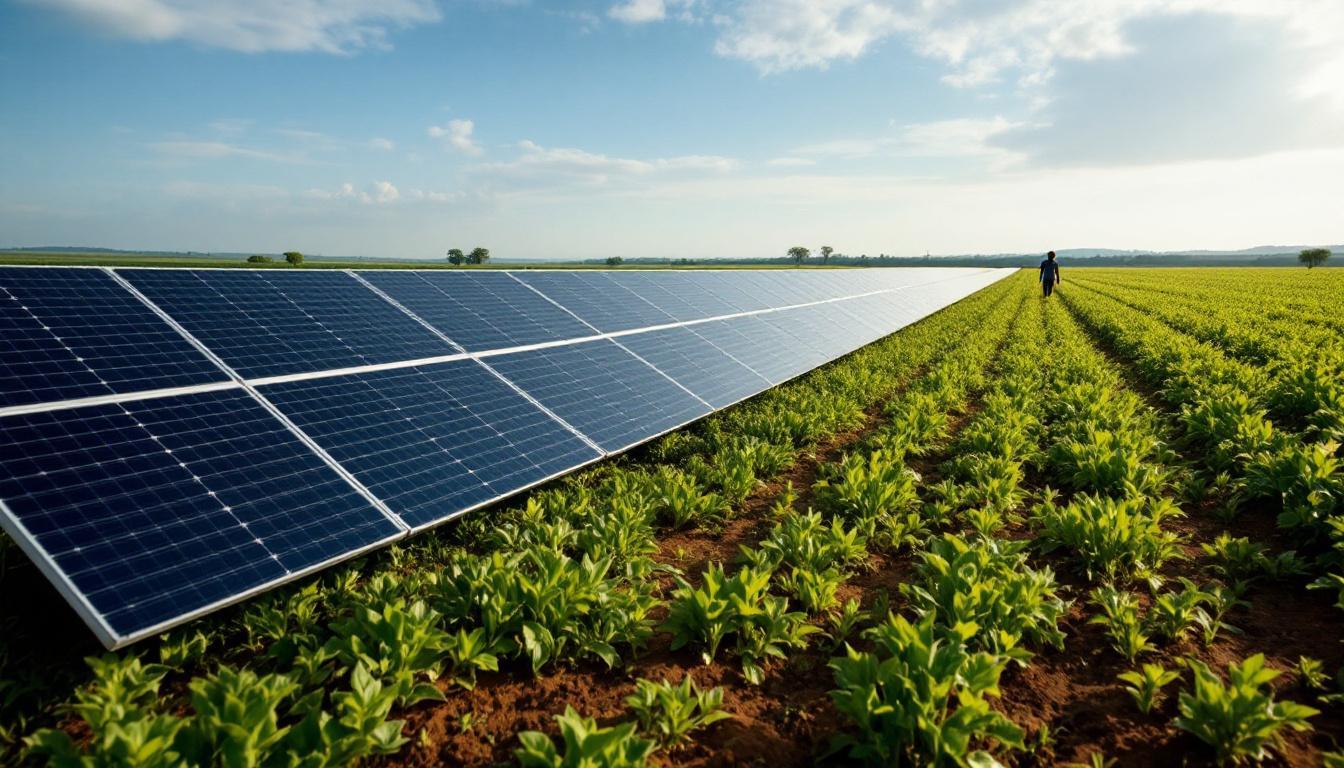
A new partnership between the World Bank and The Rockefeller Foundation aims to invest tens of millions of dollars in solar energy projects across Africa, targeting improvements in agricultural productivity and energy access amid a broader push for systemic change in the continent’s clean energy landscape.
This week’s announcement that the World Bank and The Rockefeller Foundation will commit tens of millions of dollars to support solar-powered agricultural and energy projects across Africa marks a targeted push to convert renewable potential into tangible economic and social outcomes.
According to Business Insider, the funding will be channelled through non-profit partners to deploy solar-driven cold storage, refrigerators, water pumps and grain mills in Kenya, Nigeria, Ethiopia, Sierra Leone, Uganda and the Democratic Republic of Congo. For industrial decarbonisation professionals, those interventions matter because they address two interlocking barriers to low-carbon development: unreliable power and post-harvest loss that undermines agricultural productivity and value chains.
Africa’s solar endowment is immense. Industry data shows the continent contains roughly 60% of the world’s best solar resources, yet solar contributes only a sliver of its electricity today. The International Energy Agency and World Economic Forum analysis concludes that Africa will need roughly $190 billion in annual investment between 2026 and 2030 to meet rising energy demand and climate targets, with two-thirds required for clean technologies. According to AP, around 600 million people across the continent still lack access to electricity, particularly in Central and West Africa, and Africa captured only about 2% of global clean energy investment in 2024.
Falling hardware costs and improved panel efficiency have already catalysed a wave of decentralised, microsolar deployments. A surge of inexpensive panels from China helped accelerate uptake, with imports of modules into the region having nearly tripled over recent years, a trend analysts say has enabled clean-energy “leapfrogging” for many communities. But the longer-term industrial prize for African economies is to capture more of the value chain: processing, manufacturing and component assembly rather than remaining primarily an importer of finished modules. As Clean Technica reported in 2025, African climate leaders argue the continent , which holds significant quantities of critical minerals , should be a manufacturing participant in the clean-energy transition.
The World Bank–Rockefeller funding links to broader initiatives seeking systemic change. The Rockefeller Foundation’s Mission 300 aims to extend electricity to 300 million Africans by 2030 through infrastructure investment and policy reform, and the foundation has joined forces with the Global Energy Alliance for People and Planet and Sustainable Energy for All to back the World Bank and African Development Bank’s Mission 300 platform. Those collaborations are activating technical assistance facilities, leadership structures and private-sector financing to scale electrification programmes across multiple countries.
There are early examples of how blended funding can accelerate deployment. The Rockefeller Foundation and partners supported Zambia’s ZEDSI programme, underwriting private-sector mini-grid developers with more than US$1.1 million to construct and operate 43 mini-grids intended to serve thousands of people and catalyse local economic activity. For industrial decarbonisation planners, mini-grids and modular solar-plus-storage systems present practical routes to electrify industrial clusters, agro-processing hubs and logistics nodes without waiting for centralised grid expansion.
Nonetheless, finance gaps and structural hurdles remain. Donor commitments on climate finance have repeatedly fallen short of promises, a point underscored by leaders of vulnerable island states who have urged wealthy nations to honour obligations for loss, damage and transition funding. For African policymakers the calculus is complex: they need capital to industrialise and expand energy access rapidly, but they also seek to avoid extractive arrangements that export raw materials and intellectual property while leaving jobs and manufacturing offshore.
For private investors and industrial stakeholders, the immediate implications are threefold. First, targeted capital to fund distributed solar services tied to agricultural value chains can reduce food loss, increase incomes and lower embedded emissions in food systems. Second, scaling that model at industrial scale will require concurrent investment in local supply chains, workforce development and standards to retain value on the continent. Third, blended finance structures that combine concessional public funding with private capital and technical assistance are proving the most viable route to bridge risk perceptions and mobilise larger commercial pools.
The new World Bank–Rockefeller commitments are modest relative to the estimated capital needs, but they are aligned with a broader architecture that includes Mission 300 and private–public programmes seeking to move beyond pilot projects to aggregated, investible deals. For B2B audiences focused on industrial decarbonisation, the opportunity is to design bankable projects that link distributed renewable capacity, storage and productive uses , agro-processing, cold chains, light manufacturing , so that clean power directly displaces fossil-fuelled processes and creates durable local demand for clean technologies.
As deployment accelerates, decision-makers should monitor three metrics: the degree to which local manufacturing and assembly capture value; the volume of blended finance leveraged per dollar of concessional capital; and measurable reductions in post-harvest losses and industrial fuel consumption where projects are implemented. Those outcomes will determine whether current funding rounds become a catalyst for structural change or remain incremental steps in a still-underfinanced transition.
- https://oilprice.com/Alternative-Energy/Solar-Energy/Africas-Solar-Boom-Draws-New-Investment.html – Please view link – unable to able to access data
- https://www.rockefellerfoundation.org/initiatives/mission-300/ – The Rockefeller Foundation’s ‘Mission 300’ aims to provide electricity access to 300 million Africans by 2030. This initiative involves increased infrastructure investments and comprehensive policy reforms across the entire electricity supply chain. Over 20 African countries have presented their National Energy Compacts, setting targets and identifying policy measures needed to transform the energy sector. The mission underscores the importance of African leadership, low-cost financing, and global collaboration to achieve universal electricity access.
- https://www.weforum.org/stories/2022/09/africa-solar-power-potential/ – Africa holds 60% of the world’s best solar resources, yet only 1% of its solar generation capacity. The International Energy Agency (IEA) highlights this disparity, emphasizing the continent’s vast potential for solar energy. To meet its energy and climate goals, Africa requires $190 billion in annual investment between 2026 and 2030, with two-thirds allocated to clean energy. The World Bank, IEA, and other partners have called for increased support from developed economies to develop Africa’s energy and renewables sectors.
- https://apnews.com/article/698216c8520dbaf9385e7d41515901b1 – Africa possesses significant potential for renewable energy, especially solar power, due to its abundant sunlight and vast desert areas. The KHI Solar One project in Upington, South Africa, exemplifies how solar thermal technology can generate 50 megawatts of electricity—enough to power over 40,000 homes daily. However, energy access remains a challenge, with approximately 600 million people across the continent lacking electricity, particularly in Central and West Africa. Despite holding 60% of the world’s best solar resources, Africa received only 2% of global clean energy investments in 2024, and just 1.5% of global renewable power capacity is currently installed there.
- https://www.rockefellerfoundation.org/news/geapp-rockefeller-foundation-seforall-advance-world-bank-afdb-mission-to-electrify-300-million-in-africa/ – The Global Energy Alliance for People and Planet (GEAPP), Sustainable Energy for All (SEforALL), and The Rockefeller Foundation have announced support for ‘Mission 300’ (M300), an ambitious World Bank Group and African Development Bank (AfDB) initiative launched in April 2024 to provide improved electricity access to 300 million Africans by 2030. This collaboration includes launching a new technical assistance facility, establishing an M300 Leadership Group with the AfDB and World Bank, and activating private-sector financing for electrification programs in Africa.
- https://nairametrics.com/2025/11/23/africa-holds-60-of-worlds-best-solar-resources-yet-attracts-only-2-of-energy-investment-eu/ – The European Union has highlighted the gap between Africa’s renewable energy potential and the level of investment it receives, stating that the continent holds 60% of the world’s best solar resources, yet attracts only 2% of global energy investment. Despite this, Africa faces challenges such as high capital costs, limited investment, geographic barriers, and supply chain constraints that slow progress in renewable energy deployment.
- https://www.rockefellerfoundation.org/news/private-sector-mini-grid-developers-sign-funding-agreements-to-fast-track-zambias-electrification-efforts/ – Sustainable Energy for All (SEforALL), with support from The Rockefeller Foundation, announced the first private-sector mini-grid agreements under the Zambia Energy Demand Stimulation Incentive (ZEDSI) programme. Over US$1.1 million was awarded to OnePower Zambia, Renwasol/Solar23, and Engie Energy Access Zambia (Power Corner Zambia) to support the development and operation of 43 mini-grids, bringing reliable and affordable energy to underserved areas. The overarching aim of the ZEDSI programme is to bring clean, dependable energy to more than 7,000 people, supporting Zambia’s goal of electrifying 1,000 communities and achieving universal energy access by 2030.
Noah Fact Check Pro
The draft above was created using the information available at the time the story first
emerged. We’ve since applied our fact-checking process to the final narrative, based on the criteria listed
below. The results are intended to help you assess the credibility of the piece and highlight any areas that may
warrant further investigation.
Freshness check
Score:
7
Notes:
The article references a recent announcement by the World Bank and The Rockefeller Foundation committing tens of millions of dollars to support solar-powered agricultural and energy projects across Africa. However, similar initiatives have been reported in the past, such as the ‘Mission 300’ initiative launched in April 2024 by the World Bank Group and African Development Bank to provide electricity access to 300 million Africans by 2030. ([worldbank.org](https://www.worldbank.org/en/news/feature/2024/09/19/five-ways-the-world-bank-will-achieve-mission-300?utm_source=openai)) The article does not specify the exact date of the announcement, making it challenging to assess the freshness of the information. Additionally, the article cites Business Insider and AP as sources, but without direct links or publication dates, it’s difficult to verify the timeliness of the information. The lack of specific dates and direct source links raises concerns about the freshness and originality of the content. Given these factors, the freshness score is moderate.
Quotes check
Score:
5
Notes:
The article includes direct quotes attributed to Business Insider and AP. However, without direct links to these sources, it’s impossible to verify the authenticity and context of these quotes. The absence of verifiable quotes diminishes the credibility of the article. Therefore, the quotes check score is low.
Source reliability
Score:
6
Notes:
The article is published on OilPrice.com, a platform that aggregates content from various sources. While it references reputable organizations like the World Bank and The Rockefeller Foundation, the lack of direct links to original press releases or official statements makes it difficult to assess the reliability of the information. The absence of direct source links and the reliance on aggregated content raise concerns about the source’s reliability. Therefore, the source reliability score is moderate.
Plausibility check
Score:
7
Notes:
The article discusses the immense solar potential in Africa and the need for significant investment to meet rising energy demand and climate targets. These points align with previous reports and initiatives, such as the ‘Mission 300’ initiative. However, the article lacks specific details and direct links to original sources, making it challenging to fully assess the plausibility of the claims. Given these factors, the plausibility score is moderate.
Overall assessment
Verdict (FAIL, OPEN, PASS): FAIL
Confidence (LOW, MEDIUM, HIGH): MEDIUM
Summary:
The article discusses recent investments in solar energy projects across Africa, referencing initiatives by the World Bank and The Rockefeller Foundation. However, the lack of specific dates, direct links to original sources, and verifiable quotes raises concerns about the freshness, originality, and credibility of the content. Given these issues, the overall assessment is a FAIL.