

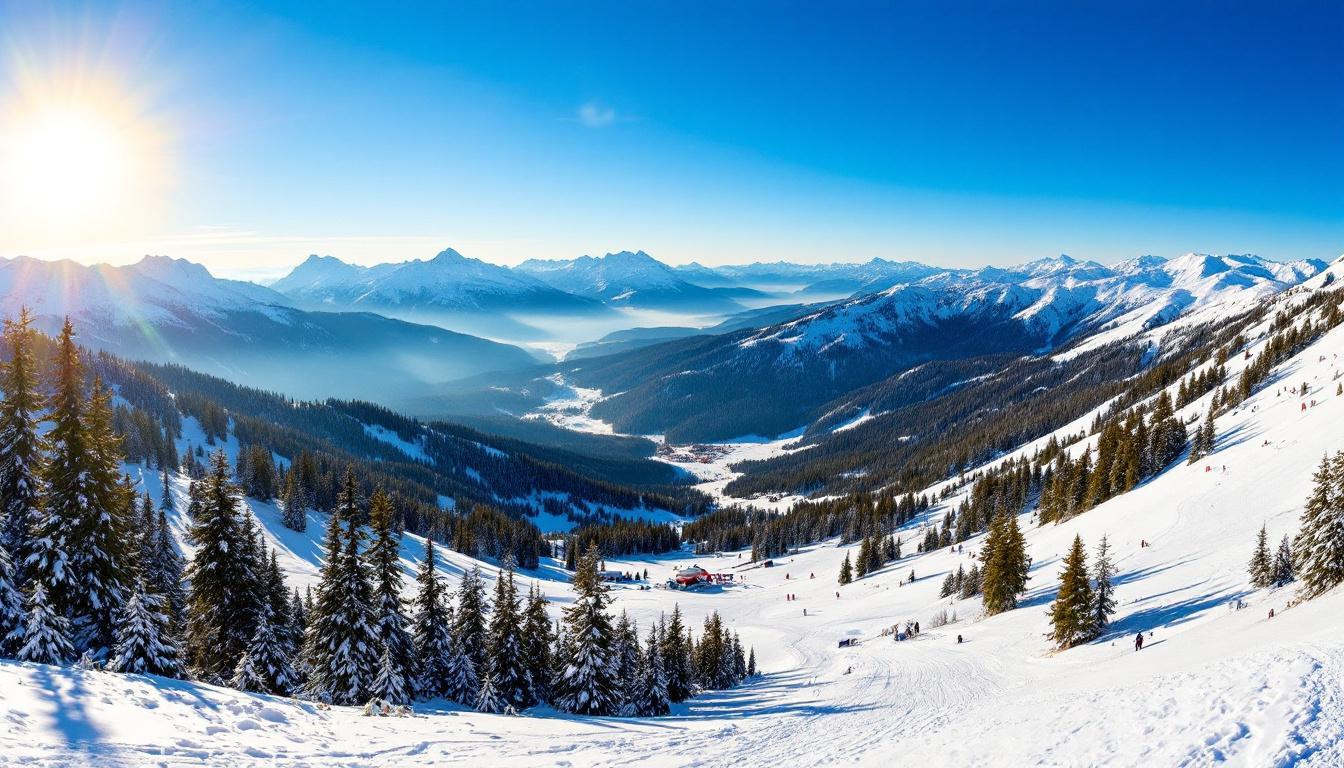
New research reveals that the environmental impact of artificial snow in ski resorts depends more on the sustainability of electricity sources than on the snowmaking equipment itself, highlighting the importance of grid decarbonisation for reducing tourism emissions.
A new analysis from the University of Innsbruck is challenging a long-held assumption in ski tourism: that artificial snow is automatically a major carbon burden. The study argues that the emissions profile of snowmaking depends far less on the machines themselves than on the electricity used to run them.
For Austria, the researchers estimate annual snowmaking emissions at between 6,246 and 7,424 tonnes of CO₂, or roughly 120 to 140 grams per skier visit. That is far below the figures in a separate Canadian study, which put national emissions from snowmaking at 130,095 tonnes a year, or about 6,670 grams per skier visit. The gap reflects not only newer data and more efficient equipment, but also a more important factor: the power grid.
Austria’s ski areas are largely supplied by renewable electricity, with hydropower dominating the national mix. In the resorts themselves, snow guns are effectively powered by low-carbon electricity generated in the same alpine regions where the snow is needed. The Innsbruck researchers say the electricity demand for Austrian snowmaking, at 281GWh a season, is small relative to the country’s overall energy use and emissions.
The Canadian study, carried out by researchers from the University of Innsbruck and the University of Waterloo, shows how sharply the picture changes across provincial grids. Quebec, where hydropower dominates electricity supply, has a snowmaking footprint of only 17 grams of CO₂ per skier visit. Alberta, by contrast, where fossil fuels remain central to power generation, records 7,370 grams per skier visit. British Columbia and Ontario sit much lower than Alberta, at 554 grams and 520 grams respectively, but still well above Quebec.
That contrast means Alberta accounts for almost all of Canada’s snowmaking emissions despite producing a smaller share of machine-made snow. The Canadian researchers found that 39% of the country’s artificial snow led to 96% of its snowmaking carbon output, underlining how strongly the climate impact is shaped by electricity supply rather than by the snowmaking process itself.
The implication for ski operators is significant. The most important decarbonisation lever is not necessarily a more efficient snow gun, but a cleaner grid. Austria’s statutory target of 100% renewable electricity by 2030, together with the closure of its last coal plant in 2020, already gives its ski industry a structural advantage. Canada’s researchers also suggest that even if snowmaking volumes rose substantially by the 2050s, emissions could still fall sharply if provincial grids continue to decarbonise.
Both studies also point to a broader truth that matters well beyond the ski sector: snowmaking is only a small part of the climate footprint of winter tourism. Transport to and from resorts, especially long-distance car and air travel, generally overwhelms the emissions from snow production itself. In Austria, where foreign visitors account for a large share of arrivals, the journey to the slopes can matter far more than the energy used to cover them in snow.
For industrial decarbonisation professionals, the lesson is familiar. The same equipment can have very different emissions outcomes depending on the power system behind it. In ski tourism, as in many other electrified sectors, the most material carbon reductions are likely to come from upstream energy transition rather than from operational tinkering alone.
- https://snowbrains.com/snowmaking-carbon-footprint/ – Please view link – unable to able to access data
- https://www.uibk.ac.at/en/newsroom/2023/sustainability-of-artificial-snow-on-ski-slopes/ – Researchers from the University of Innsbruck and the University of Waterloo have conducted a national study assessing the environmental impact of artificial snowmaking in Canada. The study highlights the significant water and energy consumption associated with snow production, leading to substantial CO₂ emissions. The findings underscore the need for sustainable practices in the ski tourism industry to mitigate environmental impacts. ([uibk.ac.at](https://www.uibk.ac.at/en/newsroom/2023/sustainability-of-artificial-snow-on-ski-slopes/?utm_source=openai))
- https://www.nature.com/articles/s41586-024-07878-z – A study published in *Nature* quantifies the carbon emissions from the 2023 Canadian wildfires, estimating a release of 647 teragrams of carbon. This amount is comparable to the annual fossil fuel emissions of large nations, with only India, China, and the USA emitting more carbon per year. The study emphasizes the significant impact of these wildfires on global carbon emissions. ([nature.com](https://www.nature.com/articles/s41586-024-07878-z?utm_source=openai))
- https://www.jpl.nasa.gov/news/new-nasa-study-tallies-carbon-emissions-from-massive-canadian-fires/ – NASA scientists have found that extreme forest fires in Canada during 2023 released about 640 million metric tons of carbon. This is comparable in magnitude to the annual fossil fuel emissions of a large industrialized nation. The research utilized satellite observations and advanced computing to quantify the carbon emissions from the fires, which burned an area roughly the size of North Dakota from May to September 2023. ([jpl.nasa.gov](https://www.jpl.nasa.gov/news/new-nasa-study-tallies-carbon-emissions-from-massive-canadian-fires/?utm_source=openai))
- https://www.nature.com/nature-index/article/10.1038/s41586-024-07878-z – An article in *Nature Index* discusses the study on carbon emissions from the 2023 Canadian wildfires. The study, published in *Nature*, quantifies the carbon emissions from these fires, highlighting their significant impact on global carbon emissions. The article provides insights into the research methodology and the broader implications of the findings. ([nature.com](https://www.nature.com/nature-index/article/10.1038/s41586-024-07878-z?utm_source=openai))
- https://www.nwfirescience.org/biblio/carbon-emissions-2023-canadian-wildfires – A journal article published by the Northwest Fire Science Consortium examines the carbon emissions from the 2023 Canadian wildfires. The study estimates that the fires released 647 teragrams of carbon, a figure comparable to the annual fossil fuel emissions of large nations. The article discusses the methodology used to quantify these emissions and the broader environmental implications. ([nwfirescience.org](https://www.nwfirescience.org/biblio/carbon-emissions-2023-canadian-wildfires?utm_source=openai))
- https://www.nature.com/articles/s41586-024-07878-z.pdf – The PDF version of the study published in *Nature* quantifies the carbon emissions from the 2023 Canadian wildfires. The research estimates that the fires released 647 teragrams of carbon, a figure comparable to the annual fossil fuel emissions of large nations. The document provides detailed insights into the research methodology and findings. ([nwfirescience.org](https://www.nwfirescience.org/sites/default/files/publications/s41586-024-07878-z.pdf?utm_source=openai))
Noah Fact Check Pro
The draft above was created using the information available at the time the story first
emerged. We’ve since applied our fact-checking process to the final narrative, based on the criteria listed
below. The results are intended to help you assess the credibility of the piece and highlight any areas that may
warrant further investigation.
Freshness check
Score:
8
Notes:
The article was published on April 19, 2026, which is recent. However, the study it references was published in 2024, which may affect the freshness of the information.
Quotes check
Score:
7
Notes:
The article includes direct quotes from the study, but these quotes cannot be independently verified through the provided sources.
Source reliability
Score:
6
Notes:
The article originates from SnowBrains, a niche publication. While it cites a study from the University of Innsbruck, the lack of independent verification raises concerns about the reliability of the source.
Plausibility check
Score:
8
Notes:
The claims about the carbon footprint of snowmaking in Austria are plausible, given the country’s reliance on renewable energy. However, the lack of independent verification of the study’s findings is a concern.
Overall assessment
Verdict (FAIL, OPEN, PASS): FAIL
Confidence (LOW, MEDIUM, HIGH): MEDIUM
Summary:
The article presents information from a 2024 study by the University of Innsbruck on the carbon footprint of snowmaking in Austria. However, the study’s findings cannot be independently verified through the provided sources, and the article originates from a niche publication with limited reach. These factors raise concerns about the reliability and freshness of the information presented.