

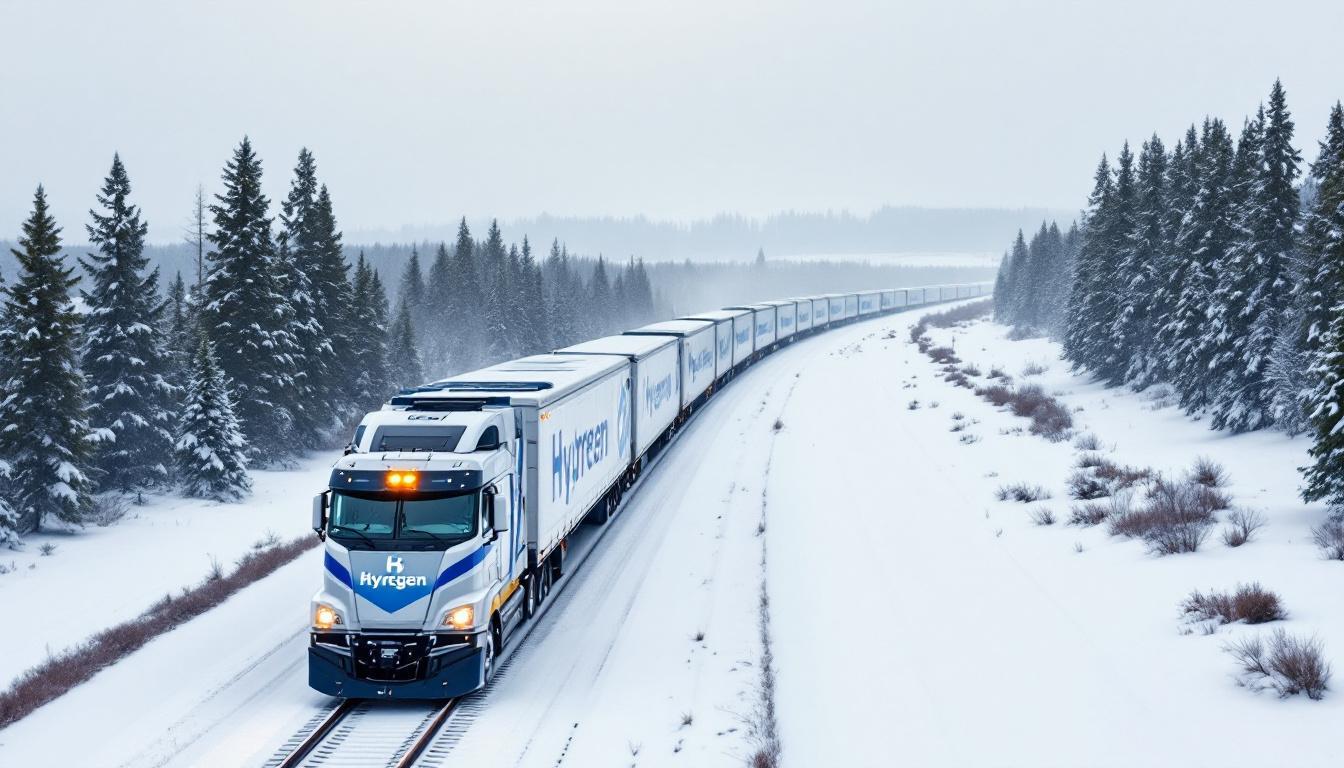
Russia’s Rostec and Chinese investors are partnering to develop a pioneering hydrogen freight corridor, signalling a shift towards sustainable logistics in one of the world’s most climate-challenged routes, with a focus on hydrogen-powered trucks suited for harsh winter conditions.
Russia’s Rostec is moving to develop a hydrogen freight corridor with Chinese investors, in a sign that cross-border decarbonisation efforts are beginning to take shape in one of the world’s most climate-challenged logistics routes.
According to statements from the state-backed group, RT-Business Development Holding has signed a memorandum with a consortium of Chinese investors to build what it describes as the first hydrogen corridor for freight transport between Russia and China. The plan centres on producing hydrogen from natural gas and installing refuelling stations along major highways linking the two countries.
The memorandum sets out the basic terms of cooperation and a roadmap for the project, while also leaving room for the creation of a joint investment fund to extend the network further into both markets. Rostec says the scheme is intended to support a new hydrogen logistics industry in Russia’s Far East, including the production of hydrogen-powered tanker trucks designed for long-haul use in harsh winter conditions.
Rostec’s partner, TopTech, is expected to help build modular hydrogen production units at filling stations. The company argues that fuel cell trucks are well suited to the region because they can refuel quickly, maintain strong range and perform reliably in sub-zero temperatures, where diesel and batteries can become less practical.
The move comes as China continues to scale up hydrogen transport infrastructure. Chinese sources say the country already has close to 600 hydrogen refuelling stations, and that its hydrogen vehicle fleet is expanding rapidly, with 3,700 new hydrogen trucks added in the first quarter of 2026.
The Russian project also follows a broader push in China to test and commercialise hydrogen freight corridors. In April, China launched its first cross-regional hydrogen heavy-duty truck route, a 1,150-kilometre line linking Chongqing with Qinzhou Port in Guangxi via Guizhou, supported by four refuelling stations. That route was promoted as a way to address the demands of long-distance haulage in difficult terrain.
For industrial decarbonisation specialists, the Russian-Chinese proposal is notable less for its immediate scale than for its system design. By combining local hydrogen production with corridor-based refuelling infrastructure, it reflects a logistics-first approach that could be easier to deploy than broad, nationwide rollout. It also shows how hydrogen is increasingly being positioned not just as an energy carrier, but as a practical tool for heavy transport in cold, remote regions where electrification faces operational limits.
Cargo traffic by road between Russia and China has already passed 6 million tonnes over the past two years, according to figures Rostec cited from Russia’s Transport Ministry. That makes the border corridor a potentially meaningful niche for alternative fuels, even if the economics of hydrogen from natural gas will continue to draw scrutiny from decarbonisation advocates.
- https://russiaspivottoasia.com/russia-and-china-to-jointly-produce-hydrogen-fuelling-stations-for-far-east-cross-border-trucking/ – Please view link – unable to able to access data
- https://interfax.com/newsroom/top-stories/117136/ – Rostec, in collaboration with Chinese investors, is preparing to implement a ‘cross-border hydrogen corridor’ project. This initiative involves constructing facilities to produce hydrogen from natural gas and establishing a network of fueling stations along highways between Russia and China. The project aims to create a high-tech hydrogen logistics industry in Russia’s Far East, facilitating the mass production of hydrogen-fueled tanker trucks with zero emissions, large power reserves, fast refueling, and excellent cold-weather performance, suitable for long-distance cross-border transportation in the region.
- https://tass.com/economy/2117471 – RT-Business Development Holding, a subsidiary of Rostec, has signed a memorandum with a consortium of Chinese investors to implement the first cross-border hydrogen corridor for freight transportation between Russia and China. The project includes creating localized hydrogen production facilities and a network of refueling infrastructure along major highways, enabling hydrogen-powered freight vehicles to operate between the two countries. The memorandum outlines key principles of cooperation and a roadmap for the project, with the potential establishment of a joint Russian-Chinese international investment fund to finance the project’s expansion deeper into both countries.
- https://www.akm.ru/eng/news/rostec-and-chinese-investors-signed-a-memorandum-on-the-implementation-of-the-first-cross-border-hyd/ – RT-Business Development Holding, part of Rostec State Corporation, and a consortium of Chinese investors have signed a memorandum to implement the first cross-border hydrogen corridor between Russia and China. The project involves local hydrogen production and a network of gas stations along main routes for hydrogen-powered trucks between the two countries. The memorandum establishes a roadmap and principles of cooperation and provides for the creation of a Russian-Chinese investment fund to scale the project inland. During the implementation, hydrogen is planned to be produced from natural gas.
- https://english.www.gov.cn/news/202504/15/content_WS67fda7a9c6d0868f4e8f1b05.html – China Petrochemical Corporation (Sinopec Group) has launched the country’s first cross-region hydrogen heavy-duty truck route, marking a milestone in advancing hydrogen energy development in China’s western regions. The route spans 1,150 kilometers from Chongqing Municipality to Qinzhou Port in Guangxi Zhuang Autonomous Region, passing through Guizhou Province. It features four hydrogen refueling stations built by Sinopec to ensure a reliable hydrogen supply network along the way. These regions are rich in hydrogen resources, with large-scale deployment of hydrogen production technologies such as water electrolysis and ammonia decomposition.
- https://www.ichongqing.info/2025/04/15/ilstc-launches-chinas-first-cross-regional-hydrogen-truck-corridor/ – The New International Land-Sea Trade Corridor (ILSTC) has launched its 1,150-kilometer ‘Hydrogen Corridor’ in Southwest China, making it the first cross-regional hydrogen truck line in China. The corridor is designed to tackle long-distance and high-altitude transport challenges, with a steep climb of over 650 meters in the Baise to Guiyang section, among the country’s most difficult hydrogen truck test routes. Ten hydrogen-powered trucks are departing from Chongqing, carrying goods like laptops, automobile parts, and low-risk chemicals to Vietnam, Laos, Thailand, and Malaysia.
- https://interfax.com/newsroom/top-stories/93223/ – Gazprom Helium Service LLC has delivered a batch of LNG to China via the Blagoveshchensk (Russia) – Heihe (PRC) international highway bridge crossing. Commercial LNG was produced at a low-tonnage natural gas liquefaction unit at Gazprom’s helium hub in the Primorye Territory. Gazprom Helium Service delivered the cargo in its own container on an LNG-powered mainline freight truck. The LNG shipment was delivered to the Chinese province of Heilongjiang and will be used in the utilities sector and as a gas motor fuel.
Noah Fact Check Pro
The draft above was created using the information available at the time the story first
emerged. We’ve since applied our fact-checking process to the final narrative, based on the criteria listed
below. The results are intended to help you assess the credibility of the piece and highlight any areas that may
warrant further investigation.
Freshness check
Score:
8
Notes:
The article was published on April 19, 2026, and reports on a memorandum signed on April 15, 2026, between Rostec and Chinese investors to establish a cross-border hydrogen corridor. This is corroborated by other sources, such as TASS, which reported on the same event on April 15, 2026. ([tass.com](https://tass.com/economy/2117471?utm_source=openai)) The information appears current and not recycled.
Quotes check
Score:
7
Notes:
The article includes direct quotes attributed to Rostec and TopTech. However, these quotes are not independently verifiable through the provided sources. The absence of direct links to the original statements raises concerns about the authenticity and accuracy of the quotes. ([tass.com](https://tass.com/economy/2117471?utm_source=openai))
Source reliability
Score:
6
Notes:
The article originates from ‘Russia’s Pivot to Asia,’ a niche publication. While it provides detailed information, the lack of a broader, more established source raises questions about the reliability and independence of the reporting. ([russiaspivottoasia.com](https://russiaspivottoasia.com/russia-and-china-to-jointly-produce-hydrogen-fuelling-stations-for-far-east-cross-border-trucking/?utm_source=openai))
Plausibility check
Score:
7
Notes:
The concept of a hydrogen freight corridor between Russia and China is plausible, given the growing interest in hydrogen energy and cross-border infrastructure projects. However, the article lacks specific details and supporting evidence to fully substantiate the claims, making it difficult to assess the feasibility and accuracy of the project.
Overall assessment
Verdict (FAIL, OPEN, PASS): FAIL
Confidence (LOW, MEDIUM, HIGH): MEDIUM
Summary:
The article presents a potentially significant development regarding a Russia-China hydrogen freight corridor. However, the reliance on a niche source, unverified quotes, and lack of independent verification from reputable outlets raise substantial concerns about the accuracy and reliability of the information. Further independent confirmation is necessary before considering publication.