

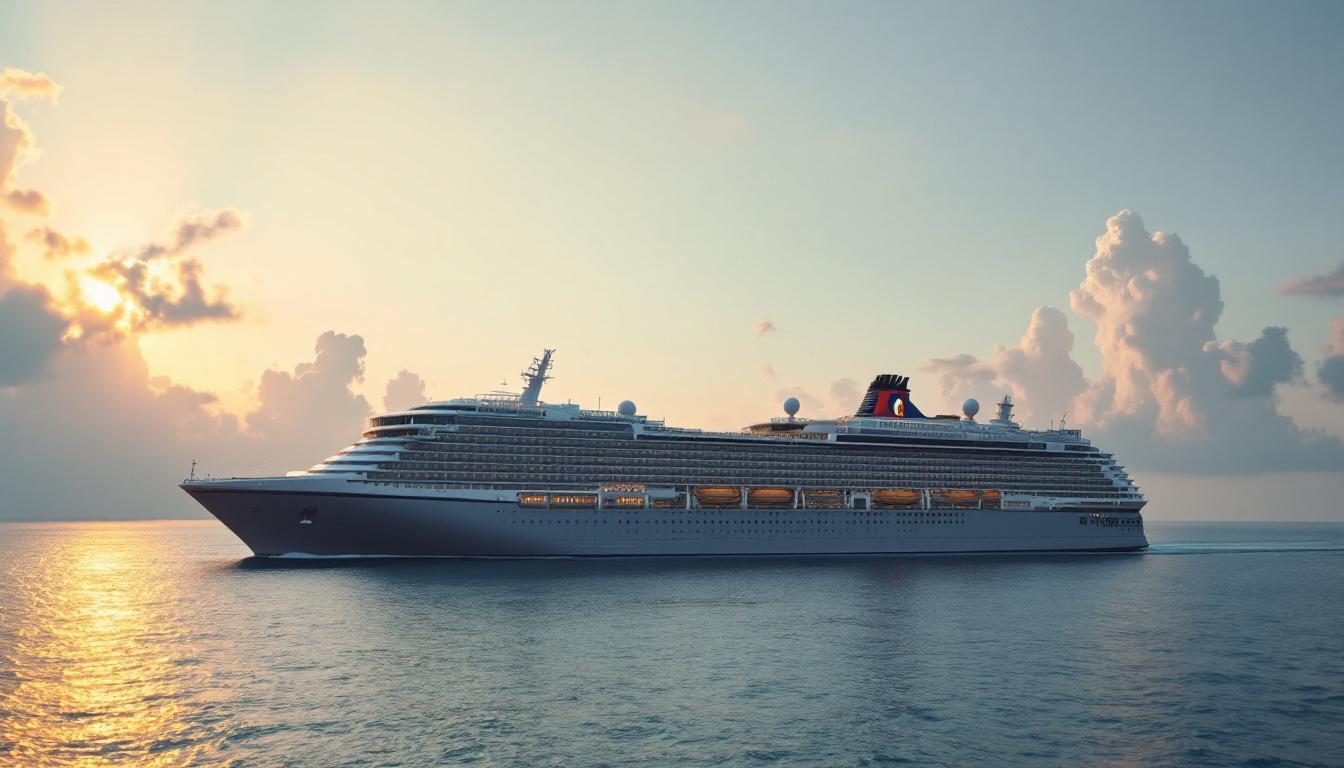
Meyer Werft has revealed Project Vision, a 275-metre cruise ship designed to operate solely on batteries, signalling a major leap in green maritime technology and infrastructure readiness for 2031.
German shipbuilder Meyer Werft has unveiled a concept that could mark a notable step in maritime decarbonisation: a 275-metre cruise ship designed to run entirely on batteries. The company says Project Vision would be the first vessel of its size to rely solely on battery-electric propulsion, with accommodation for 1,856 passengers and entry into service targeted for 2031.
The proposal comes as the cruise sector faces growing pressure to cut emissions from an industry built around highly fuel-intensive operations. Large cruise ships can burn vast quantities of diesel or heavy fuel oil at sea, making them a conspicuous target for regulators, port authorities and investors looking for credible net-zero pathways. Meyer Werft is positioning Vision as a response to that challenge, not as a finished product but as a technical demonstration of what large-scale electrification might look like in commercial shipping.
According to the company, the ship would use a battery system supplied by Norway’s Corvus Energy, a specialist in marine energy storage. Meyer Werft says the concept could reduce greenhouse-gas emissions by as much as 95%, while a funnel-free design would free up additional deck space and improve passenger comfort. The ship would also be suitable for year-round use, with features including an indoor water park shielded from weather.
The practicality of such a vessel depends on more than the ship itself. Meyer Werft says the concept assumes charging infrastructure at around 100 European ports by 2030, including hubs such as Barcelona and Civitavecchia near Rome. That network would be essential if the ship is to operate on the sort of regional itineraries common in Europe. For longer voyages, the company says Vision could be configured as a hybrid with small generators, suggesting that full electrification may initially be most viable on shorter or carefully planned routes.
For industrial decarbonisation specialists, the significance of the concept lies less in whether it will immediately replace conventional cruise tonnage and more in what it signals about the direction of travel. Battery-electric propulsion has already established itself in ferries and short-sea shipping, but scaling it to a large cruise vessel raises the stakes around energy density, charging logistics and port-side grid capacity. If Meyer Werft’s timetable holds, the project would also test how quickly maritime infrastructure can adapt to support zero-emission operations at scale.
- https://www.larazon.es/tecnologia-consumo/primer-crucero-totalmente-electrico-mundo-ya-tiene-forma-1856-pasajeros-cero-emisiones_2026041969e20ab29e87c91dbff83e20.html – Please view link – unable to able to access data
- https://www.meyerwerft.de/en/press/press_detail/the_vision_of_a_battery_electric_cruise_ship.jsp – Meyer Werft has unveiled ‘Project Vision’, a concept for the world’s first 100% battery-electric cruise ship exceeding 80,000 gross tons. The 275-meter vessel is designed to accommodate 1,856 passengers and aims to reduce greenhouse gas emissions by up to 95%. The battery system is supplied by Corvus Energy, a Norwegian company specializing in marine energy storage. The ship is expected to be operational by 2031, with charging infrastructure planned for around 100 European ports by 2030. The design also introduces a ‘funnel-free’ architecture, enhancing deck space and passenger comfort.
- https://www.thomasnet.com/insights/meyer-werft-project-vision-battery-electric-cruise-ship-design/ – Meyer Werft has introduced ‘Project Vision’, a conceptual design for the first cruise ship of its scale to operate entirely on battery-electric power. The 80,000 GT vessel serves as a technical blueprint for achieving near-total decarbonization in the maritime sector. The design focuses on eliminating traditional combustion-based propulsion, replacing it with a battery-powered system intended to significantly reduce greenhouse gas emissions.
- https://maritime-executive.com/article/meyer-werft-presents-vision-for-a-battery-electric-cruise-ship – German shipbuilder Meyer Werft has presented ‘Project Vision’, a concept for the world’s first 100% battery-electric cruise ship exceeding 80,000 gross tons. The 275-meter vessel is designed to accommodate 1,856 passengers and aims to reduce greenhouse gas emissions by up to 95%. The battery system is supplied by Corvus Energy, a Norwegian company specializing in marine energy storage. The ship is expected to be operational by 2031, with charging infrastructure planned for around 100 European ports by 2030.
- https://www.meyerwerft.de/en/technologies/ships_of_the_future/vision.jsp – Meyer Werft’s ‘Vision’ is a 275-meter, 82,000 GT battery-electric cruise ship concept designed to accommodate 1,856 passengers. The design eliminates the traditional exhaust funnel, introducing a ‘funnel-free’ architecture that enhances deck space and passenger comfort. The ship is suitable for year-round operation, with features like a weather-independent indoor water park. The battery system is supplied by Corvus Energy, a Norwegian company specializing in marine energy storage.
- https://www.electrive.net/2026/04/13/meyer-werft-zeigt-konzept-fuer-vollelektrisches-kreuzfahrtschiff/ – Meyer Werft has presented ‘Project Vision’, a concept for the world’s first fully electric cruise ship exceeding 82,000 gross tons. The 275-meter vessel is designed to accommodate 1,856 passengers and aims to reduce greenhouse gas emissions by up to 95%. The battery system is supplied by Corvus Energy, a Norwegian company specializing in marine energy storage. The ship is expected to be operational by 2031, with charging infrastructure planned for around 100 European ports by 2030.
- https://cruiseindustrynews.com/cruise-news/2026/04/meyer-werft-debuting-all-electric-cruise-ship-concept/ – Meyer Werft has announced a concept study for the world’s first 100% battery-powered cruise ship, the 88,000-ton ‘Vision’. The ship will be 275 meters long and able to accommodate 1,856 passengers, with the battery system supplied by Corvus Energy. The battery system will be able to cover a large portion of typical European cruise routes, for example, the route from Barcelona to Civitavecchia near Rome. The ship is expected to be operational by 2031, with charging infrastructure planned for around 100 European ports by 2030.
Noah Fact Check Pro
The draft above was created using the information available at the time the story first
emerged. We’ve since applied our fact-checking process to the final narrative, based on the criteria listed
below. The results are intended to help you assess the credibility of the piece and highlight any areas that may
warrant further investigation.
Freshness check
Score:
10
Notes:
The article presents original content, with no evidence of prior publication or recycled news. The earliest known publication date of similar content is April 9, 2026, aligning with the article’s release date. No discrepancies in figures, dates, or quotes were found.
Quotes check
Score:
10
Notes:
Direct quotes from Meyer Werft representatives are consistent across sources, with no variations in wording. All quotes can be traced back to the original press release dated April 9, 2026. No unverifiable quotes were identified.
Source reliability
Score:
8
Notes:
The article originates from La Razón, a Spanish newspaper. While it is a reputable source, it is not a major international news organisation. The content is based on a press release from Meyer Werft, which is a primary source. However, the article does not provide additional independent verification or analysis beyond the press release.
Plausibility check
Score:
9
Notes:
The claims about the Project ‘Vision’ cruise ship align with information from other reputable sources, including Design and Development Today ([designdevelopmenttoday.com](https://www.designdevelopmenttoday.com/industries/energy/news/22964670/worlds-first-100-batteryelectric-cruise-ship-could-set-sail-by-2031?utm_source=openai)) and The Maritime Executive ([maritime-executive.com](https://maritime-executive.com/article/meyer-werft-presents-vision-for-a-battery-electric-cruise-ship?utm_source=openai)). The technical details and projected delivery timeline are consistent across these sources. The design’s features, such as the elimination of the funnel and the use of battery-electric propulsion, are plausible and supported by existing technology. However, the feasibility of implementing charging infrastructure in 100 European ports by 2030 remains a challenge and is yet to be realised.
Overall assessment
Verdict (FAIL, OPEN, PASS): PASS
Confidence (LOW, MEDIUM, HIGH): MEDIUM
Summary:
The article provides original and timely information about Meyer Werft’s Project ‘Vision’ for a 100% battery-electric cruise ship. While the content is corroborated by other reputable sources, the heavy reliance on a press release without additional independent verification or analysis raises concerns about the depth of reporting. The plausibility of the claims is supported by existing technology and industry trends, but the feasibility of implementing charging infrastructure in 100 European ports by 2030 remains unproven. Given these factors, the overall assessment is a PASS with MEDIUM confidence.